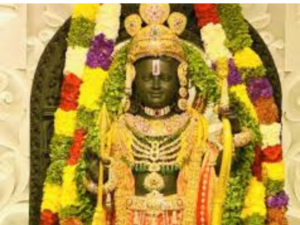
 Is there a person in this world who embodies all noble virtues?
This timeless question was once asked by the sage Valmiki to the celestial seer Narada. In the opening verses of the Ramayana, Valmiki inquires:
“Who in this world today is virtuous, brave, righteous, truthful, firm in vows, compassionate to all beings, learned, capable, and pleasing to behold?”
It is not merely a poetic curiosity. It is humanity’s eternal search. Is there an ideal human being? Or is perfection only a divine abstraction?
Let us reflect deeply.
The verse goes like this:
को न्वस्मिन् साम्प्रतं लोके गुणवान् कश्च वीर्यवान् ।
धर्मज्ञश्च कृतज्ञश्च सत्यवाक्यो दृढव्रतः ॥
चारित्रेण च को युक्तः सर्वभूतेषु को हितः ।
विद्वान् कः कः समर्थश्च कश्चैकप्रियदर्शनः ॥
आत्मवान् को जितक्रोधो द्युतिमान् कोऽनसूयकः ।
कस्य बिभ्यति देवाश्च जातरोषस्य संयुगे ॥
Ko nvasmin sāmprataṁ loke guṇavān kaśca vīryavān |
Dharmajñaśca kṛtajñaśca satyavākyo dṛḍhavrataḥ ||
Cāritreṇa ca ko yuktaḥ sarvabhūteṣu ko hitaḥ |
Vidvān kaḥ kaḥ samarthaśca kaścaika-priyadarśanaḥ ||
Ātmavān ko jitakrodho dyutimān ko’nasūyakaḥ |
Kasya bibhyati devāśca jātaroṣasya saṁyuge ||
The Human Quest for the Ideal
Every civilization has imagined an ideal person — one who combines strength with compassion, wisdom with humility, power with restraint. In leadership we seek integrity. In friendship we seek loyalty. In family life we seek love and responsibility. In society we seek justice and fairness.
Yet rarely do we find all these qualities in one individual
Modern psychology tells us that human beings are complex mixtures of strengths and weaknesses. Even great leaders possess flaws. Even saints have moments of struggle. The world today often celebrates success more than character, achievement more than integrity.
So the question remains relevant:
Does a complete embodiment of noble virtues truly exist?
Who in the world today is a person of noble virtues, courageous and powerful, who knows righteousness and is grateful, who always speaks the truth and remains firm in his vows? Who possesses excellent character, works for the welfare of all beings, is wise, capable, and pleasing to everyone? Who is self-controlled, has conquered anger, is radiant and free from jealousy, and whose righteous anger in battle is so formidable that even the gods would fear it? Through this question, Valmiki seeks to know whether there exists one ideal human being embodying all these virtues
The Answer Given by Narada
When Valmiki asked this profound question, Narada did not hesitate. He replied that such a person indeed lived — Rama
Rama, the prince of Ayodhya, was described not merely as a king or warrior, but as a living embodiment of Dharma (righteousness). He possessed courage without cruelty, authority without arrogance, love without attachment, and strength without oppression.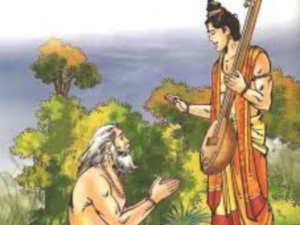
But what makes this portrayal significant is not the claim of divinity — it is the presentation of Rama as an ideal human being. The Ramayana does not depict him as someone untouched by sorrow. He faces exile, separation, betrayal, war, and personal sacrifice. Yet in every situation, he chooses the path of virtue.
This is what elevates the narrative from mythology to moral philosophy
The Sanskrit verses describe qualities such as:
-
- Guṇavān – One endowed with noble qualities? A person whose nature is naturally virtuous — compassion, humility, kindness, integrity. The word Guṇavān does not merely mean “a good person.” It refers to one who is richly adorned with inner virtues that naturally express in conduct, speech, and thought. Guṇavān is one whose character is so refined that virtue becomes his spontaneous nature, not a forced discipline. Rama does not “try” to be noble. He is nobility embodied
-
- Vīryavān – (Vigorous, Brave): A person endowed with immense strength, courage, and vitality, capable of facing challenges fearlessly and standing undeterred in the face of adversity. Lord Rama was unmatched in strength, courage, and valour. His battle against Ravana and his ability to wield divine weapons with mastery show his physical prowess and inner strength. His bravery was not just in combat but also in his willingness to embrace exile with dignity and face adversities with unwavering resolve
-
- Dharmajña – (Knows what is Right): A deep knower of Dharma, one who understands righteousness not just in theory but applies it practically, making ethical and just decisions in every aspect of life Rama was the perfect embodiment of Dharma. Every decision he took—whether obeying his father’s command, treating his subjects with justice, or upholding truth in difficult circumstances—was rooted in righteousness. He never deviated from the path of Dharma, even when it demanded immense personal sacrifice.
-
- Kritadnyaha (Grateful): One who acknowledges and appreciates the good done by others, never forgetting kindness or favours, and always repaying them with gratitude and generosity. Rama never forgot those who helped him. He expressed deep gratitude to Guha, the boatman, Hanuman, his greatest devotee, and Sugriva, who aided in the search for Sita. His grateful heart fostered loyalty and love among his followers
-
- Satyavakhyaha – Dhridavritaha (Speaker of Truth and Firm in Resolve): A person whose words are always truthful, whose promises are unwavering, and whose commitments are fulfilled with steadfast dedication, unshaken by any temptation or pressure Rama’s words were as firm as his character. He never spoke falsehood, and once he gave his word, he fulfilled it without hesitation. His adherence to truth was evident when he willingly left the throne for exile, prioritizing his father’s promise over his own coronation.
-
- Charitrena Yuktaha (Strength of Character, Appropriate in Disposition): One who embodies integrity, purity, and dignity in thought, word, and action, exhibiting a noble and virtuous character Rama’s character was flawless. He displayed unshakable ethics, respect for all beings, and an unblemished sense of duty. His unwavering faithfulness to Sita, his patience in adversity, and his fairness in judgment all reflected his spotless moral strength
-
- Sarva-bhūteṣu hitaḥ – (Concerned about the Welfare of All Beings): A compassionate soul who selflessly works for the well-being of all, showing kindness and care for every living creature, without discrimination or selfish motives Rama’s compassion was universal. He treated the Vanaras (monkeys), Nishadas (forest tribes), and even Rakshasas (demons) with kindness. His love extended beyond humans, making him an epitome of selfless service and concern for the well-being of all creatures
-
- Vidvaanaha (Scholar, an Adept): A learned and wise individual, possessing vast knowledge and deep understanding, capable of applying wisdom to guide others and uplift society. Rama was a master of Vedas, Warfare, Governance, and Philosophy. Trained by Vasishta and Vishwamitra, he absorbed deep spiritual wisdom and practical knowledge, making him an ideal ruler and a perfect disciple
-
- Samarthaha (An Able Person, a Doer): A dynamic and resourceful person who not only possesses skills and knowledge but also has the capability to take decisive action and accomplish great tasks. Rama was not just a thinker but a doer. Whether it was lifting Shiva’s bow, leading an army against Ravana, or building a bridge across the ocean, he was decisive and action-oriented. He never hesitated to act when duty called
-
- Kaschapriya Darshana (Pleasant to Look At): Endowed with a charming and graceful appearance that exudes warmth and positivity, drawing people towards him effortlessly. Rama’s physical form was mesmerizing—not just because of his handsome appearance but because his inner purity and divinity radiated from him. His face reflected peace, wisdom, and boundless compassion, making everyone around him feel uplifted.
-
- Atmavaan (Self-Composed, Joyful Presence): One who is internally strong, emotionally balanced, and spiritually aware, radiating an aura of inner peace and bliss. Rama never lost his composure, even in extreme distress. When he was exiled, betrayed, or separated from Sita, he remained calm and composed, never allowing emotions to overpower his sense of duty. His inner bliss made him serene in all situations
-
- Jita-krodha – (One Who Has Conquered Anger): A master of his emotions, who remains calm and composed even in provoking situations, displaying immense self-control and wisdom in handling conflicts. Rama never allowed anger to cloud his judgment. Even when facing Kaikeyi’s harsh demand, Ravana’s provocations, Rama acted with wisdom, patience, and restraint. He only used his power when necessary, proving his mastery over emotions.
-
- Dyutimaan (Radiant, Brilliant): Possessing a luminous presence, both in physical appearance and intellect, with an inspiring brilliance that shines through his actions and words. Rama was the very embodiment of Tejas (spiritual radiance). His aura was luminous with divine energy, and his presence was enough to inspire, heal, and uplift those around him. His brilliance was not just physical but also intellectual and spiritual
-
- Anasuyakaha (Free from Envy, Not Jealous): A noble-hearted individual who harbors no resentment, jealousy, or ill will, rejoicing in the success and happiness of others. Despite being the rightful heir to the throne, Rama never displayed envy towards Bharata. Instead, he blessed and encouraged his younger brother to rule in his absence. He had no jealousy or ill will, only love and goodwill for all
-
- .Bibhyati devāśca jātaroṣasya saṁyuge “Whose righteous anger in battle makes even the gods tremble?”This is not ordinary anger It is Dharma-born anger — anger that arises only to protect righteousness. Who has anger so righteous that it protects truth, yet so controlled that it never becomes cruelty. When inner Dharma awakens, even our deepest fears and weaknesses tremble before it.
These are not superficial traits. They demand inner mastery.
To be truthful is easy when truth benefits us. To remain truthful when it causes personal loss — that is virtue.
To be calm when praised is natural. To remain composed when insulted — that is mastery.
Virtue is not convenience; it is conscious choice.
Is Perfection Possible in Modern Times?
Skeptics may argue that such perfection is unrealistic. The pressures of modern life — competition, economic stress, social complexity — make it nearly impossible to maintain flawless character.
However, perhaps the question is not about flawlessness.
Perhaps it is about integration.
A noble person may not be perfect in the absolute sense, but they consistently strive toward higher values. They align thought, speech, and action. They make mistakes, yet they correct themselves. They experience anger, yet they do not become slaves to it.
In this sense, the embodiment of noble virtues becomes a dynamic journey rather than a static state.
The Ideal as Inspiration, Not Comparison
The figure of Rama in the Ramayana serves as a mirror rather than a measuring stick. He is not presented to discourage humanity but to inspire it.
When Rama accepts exile to honor his father’s promise, he demonstrates integrity over comfort.
When he treats even his enemies with dignity, he demonstrates compassion over hatred.
When he leads with responsibility rather than domination, he shows that true leadership is service.
These episodes are not meant to say, “You can never be this.” They gently whisper, “You can try.”
The Psychological Dimension
From a psychological perspective, the idea of a perfectly virtuous person fulfills a deep human need. We seek stability in a world of chaos. We long for moral clarity in times of confusion.
An ideal figure serves as a moral compass. Whether in the form of Rama, or other cultural ideals, the presence of such archetypes shapes collective ethics.
In India, Shri Rama is often called Maryada Purushottama — the Supreme Upholder of Ethical Conduct. The emphasis is not merely on power but on restraint. Not on victory alone, but on rightful victory. Shri Rama, the central figure of the Ramayana, is not just a historical personality; he represents pure, unshakable joy (Ananda). Unlike fleeting happiness, which depends on external factors, Rama’s joy is rooted in inner peace, unwavering faith, and complete alignment with Dharma. His life illustrates how true bliss emerges from selflessness, love, and surrender to a higher purpose
This is profoundly relevant today.
Can We Become That Person?
The deeper question is not whether someone else embodies all virtues. The real question is:
Can we cultivate these virtues within ourselves?
Each day presents opportunities:
-
- When faced with dishonesty, can we choose truth?
-
- When provoked, can we choose restraint?
-
- When in power, can we choose fairness?
-
- When hurt, can we choose compassion?
Virtue is not inherited; it is practiced.
Shri Rama’s life, as narrated in the Ramayana, suggests that nobility is built through choices made consistently over time. Throughout the Ramayana, Shri Rama encounters triumphs and trials alike, yet his inner joy remains undisturbed. His ability to remain serene, compassionate, and blissful even in adversity teaches us that joy is not about circumstances but about one’s inner state. Let’s explore key moments in his life that highlight his divine joyfulness.
The Balance Between Strength and Softness
One remarkable aspect of Rama’s character is balance.
He is a fierce warrior on the battlefield, yet tender in personal relationships. He is decisive as a ruler, yet deeply reflective as a son and husband. He displays righteous anger when necessary, yet never descends into uncontrolled rage.
This harmony of opposites is perhaps the true mark of nobility.
Modern society often swings between extremes — aggression or passivity, ambition or apathy. The ideal person harmonizes these polarities.
The Eternal Relevance of the Question
Valmiki’s question is timeless because it is ultimately about human potential.
Is there someone who embodies all noble virtues?
In the epic narrative, the answer is Rama.
In philosophical reflection, the answer becomes more subtle: such a person exists whenever an individual aligns fully with Dharma.
Perhaps the question is not meant to be answered once and for all. It is meant to awaken aspiration.
Conclusion: The Ideal Lives Through Us
Whether one views Rama as a historical prince, a divine incarnation, or a symbolic archetype, the central message remains powerful:
Human life can be elevated through character.
The embodiment of noble virtues is not merely about supernatural perfection. It is about unwavering commitment to truth, compassion, courage, and self-control.
Valmiki asked the question seeking an ideal. Narada responded with a name.
Today, the question echoes again.
Maybe the world does not need one perfect person.
Maybe it needs millions striving toward nobility.
And perhaps, in the quiet choices of daily life — in honesty practiced, anger restrained, promises kept, and kindness extended — the ideal human quietly begins to emerge.
The search for the perfectly virtuous person ultimately turns inward.
The possibility lives within us.