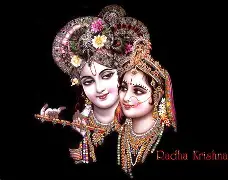
There is a deep metaphysical significance of Radha Rani, which describes her as the essential “joy-giving” energy or Ahladini Shakti of the divine. It is a unique “secret” attributed to Hanuman, revealing that the name Radha is a code which, when reversed, becomes Dhara, representing the continuous flow of a devotee’s consciousness toward the creator. Addressing a seeker’s confusion regarding which deity to worship, the Guru emphasizes that all divine forms are interconnected and that true devotion is defined by one’s internal emotional state rather than rigid external labels. He specifically highlights a famous couplet by the poet Bihari Lal as a powerful tool for spiritual resonance, suggesting its recitation can align a practitioner’s energy with the divine. Ultimately, the text serves as a guide for practitioners to transcend religious hesitation and maintain an unbroken stream of faith to achieve spiritual liberation
In a spiritual context, this “Dhara” represents the unbroken stream of the individual soul (jeevatma) continuously flowing towards the Supreme Divine (paramatma). More specifically, it symbolizes the inner stream of profound emotion (bhava) and devotion (bhakti).
Some deep insights into this concept:
- The Unbroken Journey: Just as a river’s stream must remain continuous to successfully reach and merge with the ocean—because if it breaks, the earth will simply absorb the water before its journey is complete—a devotee’s inner stream of devotion must also remain completely uninterrupted.
- Avoiding Obstructions: This inner flow is frequently obstructed by the “stones of doubt,” such as getting confused over which specific deity one should or shouldn’t worship. Introducing these doubts breaks the continuous flow of devotion and disrupts the spiritual journey.
- Union with the Divine: The ultimate goal is to keep the flow of this inner stream (Radha) swift and continuous. When this stream of devotion flows with intense momentum, it dances as Radha and ultimately becomes one with Krishna, signifying the beautiful spiritual state where Radha and Krishna become a single entity.
Therefore, to truly understand and connect with Radha is to cultivate and protect this continuous, unbroken stream of devotion within yourself, ensuring it flows steadily toward the divine
The Divine (Sachchidananda Bhagwan) possesses three main powers: Sandhini, Samvit, and Ahladini
- Sandhini (The Power of Existence): This is the fundamental divine energy that forms the basis of all existence. Through this power, the Lord grants life to Himself and to all living beings. Sandhini sustains not only the physical universe but also divine, eternal realms like Vrindavan and Vaikuntha. Lord Balarama is considered the presiding deity of this foundational power.
- Samvit (The Power of Knowledge): This power represents consciousness, divine knowledge, and understanding. It provides “true knowledge,” which is the realization by the individual soul (jeevatma) that its ultimate goal is to journey toward and reach the Supreme Divine (paramatma). Samvit encompasses the intellect and the capacity to think, serving as the bridge that unites the soul with God.
- Ahladini (The Power of Bliss): Considered the highest of the three, this is the supreme power of joy and bliss. It is the energy that brings delight not only to the devotees but to the Lord Himself. Radha Rani is the ultimate embodiment and presiding deity of this Ahladini power. Representing supreme love, compassion, and devotion, she utilizes this power to provide immense, loving bliss directly to Lord Krishna
मेरी भव बाधा हरौ, राधा नागरि सोय।
जा तन की झाईं परे, स्याम हरित दुति होय॥

O Radha! Please remove my worldly troubles. Even the shadow of your divine body turns Krishna’s dark complexion into a glowing green radiance

सतसैया के दोहरे, ज्यों नावक के तीर।
देखन में छोटे लगें, घाव करें गंभीर॥

The couplets of Bihari are like arrows of a skilled archer —small in appearance but deeply piercing.
The verse “Meri Bhav Badha Haro, Radha Nagar Soi; Ja Tan Ki Jhai Pare, Shyam Harit Duti Hoi” is a profound couplet (doha) written by Mahakavi Bihari Lal. It serves as the invocation (Mangalacharan) for his famous work, Bihari Satsai.
Here is the breakdown of its meaning:
- “Meri Bhav Badha Haro Radha Nagar Soi”: In this first half, the poet is praying to Radha Rani. Nagar means clever or wise. The poet prays, “O clever and wise Radha Rani, please remove (Haro) all of my worldly obstacles, troubles, and miseries (Bhav Badha)”.
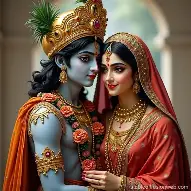
- “Ja Tan Ki Jhai Pare Shyam Harit Duti Hoi”: This half beautifully illustrates her supreme divine influence over Lord Krishna. It means that by the mere falling of the shadow or reflection (Jhai) of Radha Rani’s body, the dark-complexioned Lord Krishna (Shyam) becomes “green” or radiant (Harit Duti). In a spiritual and poetic sense, becoming “green” means that even if Lord Krishna is sitting in sadness, just the shadow of Radha Rani falling upon Him makes His entire being bloom with immense joy, happiness, and supreme delight.
The Overall Meaning and Significance: The poet is expressing that if the mere shadow of Radha Rani is enough to bring supreme bliss and radiance to the Supreme Lord Krishna, then surely she has the boundless power to wipe away the countless miseries of a devotee’s worldly life.
Furthermore, the sources highlight a secret spiritual significance to this verse: it is highly recommended for devotees of Radha Rani to memorize and continuously chant this doha. Because it was written by Bihari Ji with profound devotion, chanting it aligns a devotee’s spiritual vibrations directly with Radha Rani, instantly making her attentive to their call
Chanting the verse “Meri Bhav Badha Haro” acts as a highly potent catalyst in a devotee’s spiritual journey in several specific ways:
- Aligning Spiritual Vibrations: When a devotee continuously chants this couplet, his inner “electrical vibrations” (vidyut tarange) align perfectly with the profound, pure devotional state that Mahakavi Bihari Ji was experiencing when he originally composed it.
- Instantly Capturing Radha Rani’s Attention: Because the verse contains such powerful energy and uses Bihari Ji’s specific vocabulary, chanting it makes Radha Rani immediately alert and attentive to the devotee’s call. The sources emphasize that continuous chanting will absolutely please and win her over
- A Prerequisite for Worship: That any worship or adoration of Radha Rani is considered completely incomplete if a devotee does not begin by remembering or chanting this specific verse. It is highly recommended to memorize the verse and chant it with deep meditation.
Sustaining the Inner “Dhara” (Stream): Tying into the secret meaning of Radha as “Dhara” (the continuous stream of devotion), when a devotee successfully clears away the “stones of doubt” and allows their inner stream of devotion to flow powerfully, this verse naturally resonates from within their heart
Ultimately, chanting this verse is a deeply resonant way to call upon Radha Rani’s wisdom to remove the countless obstacles and miseries of the material world (bhav badha), thereby ensuring the soul’s journey toward the Divine remains completely unbroken.
Radha Rani is considered the highest of the three main divine powers because she is the ultimate embodiment of Ahladini Shakti , which is the supreme energy of joy and bliss.
This power is considered the most superior because it is the specific divine energy that provides immense delight and bliss not only to the devotees, but to Lord Krishna Himself. As the presiding deity (adhishtatri devi) of this bliss-giving power, Radha Rani is Lord Krishna’s intimate, personal energy (antarang shakti or swaroop shakti).
Through this Hladini power, she offers supreme, loving joy directly to Krishna, to the extent that scriptures state Lord Krishna Himself is subordinate to Radha. Because she represents the very essence of supreme love, compassion, and devotion, she is recognized as the highest manifestation of the Divine’s energy
In the context of devotion, the Samvit power plays the crucial role of awakening the soul by providing “true knowledge” and divine consciousness.
Its primary functions in a devotee’s spiritual journey include:
- Realization of the Ultimate Goal: The most significant role of the Samvit power is that it makes the individual soul (jeevatma) acutely aware that its ultimate purpose is to journey toward and ultimately reach the Supreme Divine (paramatma). This realization is the very foundation of “true knowledge”.
- Acting as the Bridge to the Divine: Derived from a Sanskrit root meaning understanding , Samvit encompasses the intellect and the capacity to think. It is precisely this capacity of conscious thought and understanding that unites and connects the individual soul with God.
- Fostering Spiritual Cognition: Beyond just intellectual thought, Samvit governs a wide array of inner spiritual experiences necessary for devotion. It is the source of supreme knowledge, awareness, intuition, and realization. Furthermore, it facilitates the deep inner acceptance, consent, and acknowledgment required to fully surrender to the divine path.
In essence, while the Sandhini power grants existence and the Ahladini power provides bliss, the Samvit power provides the essential consciousness and intellect required for the soul to recognize its separation from God and purposefully seek union with Him