The Valmiki Ramayana is a monumental epic that has guided humanity for millennia, and at its very core lies the Sundara Kanda, its fifth and most celebrated chapter. Unlike the other sections of this revered scripture, the Sundara Kanda is uniquely distinguished because its primary hero is not Lord Rama, but his supreme devotee, Lord Hanuman. It is universally regarded by scholars and devotees alike as the very “heart” of the epic, serving as a profound narrative that represents hope, unyielding devotion, and the absolute triumph of the spirit.
The Spiritual Significance
The Epic Odyssey: Hanuman’s Journey to Lanka
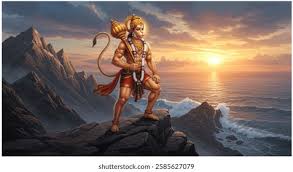
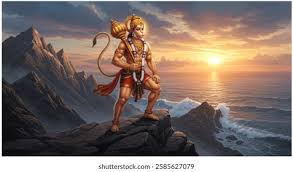
The narrative essence of the Sundara Kanda is a breathtaking adventure. The epic story initiates with Lord Hanuman standing upon Mount Mahendra, gathering his monumental strength to take a massive leap of faith across the vast ocean. His divine mission is singular: to find Mother Sita, who had been unjustly abducted by the formidable demon king, Ravana.
The spiritual depth of the Sundara Kanda is immense. It is often recited daily as a powerful prayer because it functions as a divine manual for overcoming seemingly “impossible” odds in life. From a deep numerical and spiritual perspective, the entire 24,000-verse Valmiki Ramayana was composed to mirror the 24 letters of the highly sacred Gayatri Mantra, with every 1,000th verse beginning with the corresponding next letter of the mantra. Because of this profound cosmic alignment, in the tradition of ritual chanting (Sundara Kanda Parayana), reciting just a single chapter of the Sundara Kanda is said to yield a “1000-fold” merit, making it spiritually equivalent to chanting the Gayatri Mantra 1,000 times. Many devotees firmly believe that immersing oneself in this Kanda creates a remarkably “beautiful” environment in a person’s life, systematically removing stubborn obstacles and replacing paralyzing fear with boundless courage.
As Hanuman navigates the skies, he is forced to negotiate several daunting hurdles mid-air. He first encounters Mainaka, a radiant golden mountain; then Surasa, the terrifying mother of serpents; and finally Simhika, a vicious shadow-grabbing demoness. Hanuman brilliantly overcomes these monumental challenges through an impeccable combination of immense physical strength, quick wit, and deep humility.
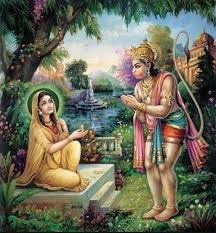
Upon finally reaching the shores of Lanka, Hanuman strategically shrinks his physical size to stealthily explore the heavily guarded enemy city. His relentless search eventually leads him to the beautiful Ashoka Vatika, where he finds mother Sita deeply grieving beneath a tree, yet remaining absolutely steadfast in her unshakeable virtue. Hanuman respectfully approaches her, establishing his authenticity by presenting Lord Rama’s signet ring, and valiantly offers to carry her back to safety. However, Sita respectfully refuses this offer, firmly stating that Rama himself must be the one to defeat Ravana and reclaim his rightful honor.
Before departing, Hanuman decides to test the military strength of Ravana and deliver a stern warning. He deliberately allows himself to be captured by the enemy forces. When Ravana arrogantly orders Hanuman’s tail to be set on fire, Hanuman effortlessly escapes his physical bonds and utilizes his blazing tail to unleash absolute havoc, burning down large swaths of the city of Lanka. Having successfully completed his reconnaissance, Hanuman leaps back across the ocean to reunite with Lord Rama, delivering the soul-stirring, beautiful message: “Seen has been Sita” (Drishta Sita). This victorious and deeply hopeful conclusion marks a monumental turning point in the epic, shifting the narrative from deep tragedy toward the ultimate triumph realized in the subsequent Yuddha Kanda.
The Meaning and Significance of “Sundara”
Most books of the Ramayana are named after geographic locations, such as Ayodhya or Aranya, or significant events like Yuddha (war). The Sundara Kanda, however, stands apart because it is named after a specific attribute: Sundara, which directly translates to “Beautiful”.
A famous traditional Sanskrit verse beautifully encapsulates this pervasive beauty: Hanumato’pi sundaryam, sundaryam Jānaki-tathā | Sundaryam Rāghavasyāpi, tad-sundaraṃ kāṇḍam ucyate ||. This profound verse explains that in this Kanda, Hanuman is beautiful through his magnificent deeds and devotion; Janaki (Sita) is beautiful in her steadfast virtue; and Raghava (Rama) is beautiful in his pure love and longing. “Therefore, this Kanda is called Sundara (The Beautiful Chapter)”.
Beyond this verse, scholarly tradition offers five distinct reasons for this unique title:
- The Beautiful Hero: Hanuman’s mother, Anjana, affectionately called him “Sundara” as a childhood nickname, and since this entire chapter is a solo journey dedicated solely to his extraordinary exploits, it beautifully honors him. It further highlights his inner beauty—his incredible selfless devotion and high intellect.
- The Beauty of Hope: Preceding chapters are deeply steeped in the gloom of Sita’s abduction and Rama’s crushing despair. Here, for the first time, we witness a beautiful turning point where hope is fundamentally restored. The Chapter contains the “beautiful” news that Sita is alive and well.
- The Beauty of the Location: Much of the narrative unfolds in the Ashoka Vatika, which Valmiki describes with exquisite, celestial imagery. The lush gardens, the intricate architecture of Lanka, and the descriptions of Hanuman’s flight represent the absolute pinnacle of Sanskrit imagery.
- The Beauty of Character: The narrative highlights Sita’s unshakeable dharma; despite being a helpless prisoner, she remains morally superior to her captor, Ravana. It also showcases Hanuman’s absolute selflessness, as he does everything for his master without seeking any personal gain whatsoever.
- The “Sundara” Meter: Valmiki’s poetic composition in this section utilizes a profoundly melodic Sanskrit prosody. The rhythmic flow of the verses perfectly captures the momentum of Hanuman’s epic leap and the deep emotional resonance of the dialogues between Hanuman and Sita, making it the most aesthetically pleasing poetry in the epic.
The Spiritual Inner Meaning of Sundar Kanda
In Sundara Kanda we see Hanuman starting in search of Sita. Hanuman starts in search of Sita with a special order from Rama, with a token given by him . Sita means that which was found by the ploughing the soil. King Janaka found a baby while ploughing the soil. And he promptly named her Sita
In this body, which is the domain of all actions, the intellect locates the “Self” by its constant search or digging. That is very much like ploughing the soil. That means the search for Sita is akin to the “Self” that is to be discovered too. This intermingling of search for Sita and search for Self is what makes Sundarakanda special.
Rama is an incarnation of the Supreme being. It means that Hanuman started the search with the approval of the Supreme being, carrying a token given by him. Thus Hanuman starts in search of Sita or ‘Self’ well equipped by the Supreme being. Sita got separated from Rama who went in pursuit of a golden deer to please Sita. Sita’s separation is very much like the Jivatma getting separated from Paramatman while running after objects of life
What is purpose of Hanuman’s search? To unite Sita with Rama. Uniting the Self with Paramatman
That means embedded in the story of search for Sita, is the inner story of search for ‘Atma’ or Self, and the unification of Jivatma with Paramatma. Any such search /spiritual activity requires a Guru. Here the Guru is Hanuman himself. Hanuman is called ” Shatrukarshanah “. It means, one who can crush the enemies. Hanuman is the one who can crush the Rakshasas troubling Sita. Hanuman is also one who crushes the inner enemies.
Ravana is the one who forces the thoughts of ‘me’ and ‘mine’ , that is the raging mind or the ego. It is ego that colours everything around as ‘mine’ or for ‘me’. Ravana is nothing but our raging mind. Sita or the “Self” was carried away by the ‘raging mind’ called Ravana. Hanuman started his search for Sita or the Self which was carried away by a Ravana, with the ultimate object of uniting Sita or the Self with Rama, the incarnation of the Supreme Being (Paramatman). In the spiritual enquiry, the unification of Self or Jivatman with the Paramatman is the ultimate goal. That is the same goal in Sundarakanda. That, reading this first sloka, or meditating on this sloka is the way for liberation is the thought of many. He starts off following the path trodden by the Rishis Thus we see Hanuman in Sundarakanda, as one with the blessings of Bhagavan, as a Bhakta as well as a messenger of Rama
Management Lessons: A Handy Guide for Building Efficiency
Beyond its undisputed religious significance, modern scholars and management experts frequently refer to the Sundara Kanda as a comprehensive “Manual for Success“. It brilliantly outlines a systematic psychological and strategic framework for achieving goals that appear completely impossible to the ordinary mind.
The Strategy of “The Leap” (Goal Initiation) Any successful endeavour requires the difficult transition from mere planning to active execution. Hanuman’s monumental leap over the ocean represents the essential First Step—often the most paralyzing phase of any massive project. Before leaping, Hanuman demonstrates the vital importance of self-correction; he prays and centres himself, perfectly aligning his immense physical strength with his focused mental intent. Once he leaves the shore, he operates with absolute commitment, proving that there can be no “Plan B”. This teaches humanity that half-hearted attempts rarely lead to meaningful breakthroughs. Furthermore, Hanuman teaches us the ultimate power of a “leap of faith”; he acted on his potential and purpose without knowing for certain if he could cross the ocean, successfully illustrating that self-doubt is the only real barrier to success.
Overcoming Hurdles with Strategic Agility Hanuman’s mid-air journey presents three distinct obstacles, each deeply symbolic of the hurdles we face in our careers or personal endeavours:
- Mainaka (The Golden Mountain): Representing temptation and comfort, Mainaka offered Hanuman a luxurious place to rest. Hanuman’s swift but polite refusal teaches the essential success principle of Avoiding Distractions; true success demands the strict discipline, and focus, to completely reject comfort until the primary job is done.
- Surasa (The Serpent Mother): Representing competitive ego and bureaucracy, Surasa forcefully attempted to swallow him. Hanuman displayed remarkable Intellectual Flexibility and agility. As she expanded her mouth, he intelligently grew larger, and then suddenly shrank to a tiny size to safely fly right out of her mouth. This powerful lesson highlights adaptability—teaching us that while some problems require immense strength, others simply require a clever change in perspective and to adapt our ego and methods to the situation.
- Simhika (The Shadow Demon): Representing our darkest internal fears and hidden insecurities, Simhika caught Hanuman by his very shadow. Hanuman utilized Direct Confrontation, realizing he had to strike her heart directly to survive. This boldly demonstrates that certain deep-rooted problems must be decisively destroyed, rather than delicately negotiating with them.
SWOT Analysis and Resourcefulness Upon successfully infiltrating Lanka, Hanuman completely avoids a hasty, reckless attack. Instead, he executes a flawless display of Situational Awareness. He actively gathers vital information by disguising himself, meticulously studying the enemy’s city layout, evaluating their military strength, and assessing the overall morale of the populace. He brilliantly conducts a risk assessment to calculate the optimal time to approach Sita to ensure he isn’t mistaken for an enemy spy or demon. Finally, he utilizes Lord Rama’s signet ring for validation, effectively serving as a modern “Proof of Concept” to successfully build essential trust with a highly skeptical stakeholder.
Perhaps his greatest display of organizational efficiency and resourcefulness occurs during his capture. When the enemy sets his tail ablaze, Hanuman actively refuses to panic. Instead, he remarkably turns a dire threat into an extraordinary opportunity. Demonstrating spectacular innovation, he uses the very fire intended for his destruction as a strategic tool to illuminate and map the city’s vulnerabilities while simultaneously destroying the enemy’s critical infrastructure. This profound resilience beautifully proves that a true leader must have the capacity to thrive under extreme pressure, utilizing the sheer “heat” of an unexpected crisis to clearly illuminate the path forward.
Mastering Communicative Skills
The Sundara Kanda provides incredible, timeless insights into effective communication. Upon returning to Lord Rama, Hanuman does not launch into a long, self-serving narrative about his epic battles, the demons he defeated, or his burning of Lanka. His very first words are simply “Drishta Sita” (Seen is Sita).
This perfectly encapsulates the vital modern communication principle of Clarity over Chronology. In contemporary communication, individuals frequently “bury the lead” by focusing on the timeline rather than the result. Hanuman expertly front-loaded the most critical piece of information to instantaneously relieve Lord Rama’s deep, consuming anxiety. Additionally, his communication is laced with profound humility. Even though he had single-handedly located Sita and devastated Lanka, Hanuman gracefully credited his massive success entirely to Rama’s divine grace. This teaches humanity that true, long-lasting success is only sustainable when it is closely coupled with genuine humility.
A Path of Spiritual Progress and Ultimate Transformation
Through Hanuman’s majestic character, we are provided with the absolute blueprint of the Ideal Messenger, solidly built upon the “Four Pillars of Success”: Jnana (Knowledge), Bhakti (Devotion), Yasha (Discretion), and Shakti (Power). Concurrently, Sita’s unwavering character in the Ashoka Vatika serves as a stunning masterclass in resilience and mental fortitude in the face of severe adversity. She showcases exactly how to keep one’s mind firmly anchored to core spiritual values even when completely surrounded by hostile threats and literal monsters.
Ultimately, the Sundara Kanda heavily transcends its status as merely an ancient epic scripture. It is deeply revered as a beautifully enriching, spiritually transformative text that promises immense spiritual merit while simultaneously providing highly actionable intelligence for navigating the complexities of the modern world. By learning to emulate Hanuman’s brave leaps of faith, his brilliant intellectual agility, and his masterly, humble communication, any individual can effectively chart a clear, confident path toward both tangible worldly efficiency and profound, lasting spiritual progress.
Many devotees believe that reciting this Kanda creates a “Beautiful” environment in one’s life, removing obstacles and replacing fear with courage—just as Hanuman replaced Rama’s sorrow with the beautiful news of Sita